In this article
- Le séminaire d'entreprise est un temps de travail collectif structuré pour avancer sur des sujets précis comme la stratégie ou la formation.
- Le séminaire vise à produire de la clarté et des résultats concrets, avec des objectifs opérationnels comme partager la stratégie ou lancer un projet.
- Le team building privilégie le lien humain et la cohésion par des activités ludiques, sans réunion ni ordre du jour formel.
- Le team building désamorce les tensions, améliore la communication et révèle des soft skills essentielles au travail en équipe.
- La tendance 2026 favorise les formats hybrides combinant séminaire le matin et team building l'après-midi pour allier travail et cohésion.
In a professional context, the difference between a seminar and team building is important. Choosing the right format means ensuring that the event really serves your employees and your organisation. In this guide, we detail the objectives, formats and uses of each to help you make a clear decision.
The company seminar: a structured time for collective work
A company seminar is a collective working time organised outside the usual professional environment. It brings together a team, a department or the whole company to make progress on a specific subject: strategy, training, decision-making or coordination. The format can last from half a day to several days, depending on the level of immersion required. A residential seminar adds one or more overnight stays, facilitating informal exchanges and concentration over several working sessions.
In practical terms, you use it when people need to work together, not just get together. A marketing team can use it to frame its annual action plan, a management team can use it to decide on strategic priorities, and a sales department can use it to prepare for the year ahead. The purpose of the seminar is to create clarity within the company, not to entertain.
Typical objectives of a company seminar
Seminars meet very operational needs. It becomes useful as soon as a group of employees needs to share a common vision or take decisions with real dedicated working time.
- Sharing company strategy or annual objectives with all participants.
- Train employees on a specific subject: tools, methods, processes or new skills.
- Align teams after a period of change: merger, reorganisation or crisis.
- Launch a new project or product internally to stimulate buy-in.
- Take stock of a year and set the next course in a framework that encourages reflection.
The right approach is to link each seminar to an expected outcome. If the day is not expected to produce anything concrete, you are probably looking for another type of event.
Who organises a seminar and how often?
Seminars are organised by management, HR, managers or the marketing and sales teams, depending on what is at stake. The frequency then depends on the type of seminar being organised:
- An executive committee will hold a seminar twice a year to define strategy.
- A sales team schedules it at the beginning of the year to launch objectives.
- An entire company uses it as an annual kick-off to get all employees pulling in the same direction.
If you're preparing this type of corporate event, our guide to organising your residential seminar will help you frame the essential stages. At the same time, our article on the ideal length of a residential seminar helps you adjust the format to the right level of ambition.
Team building: priority to human bonds and cohesion
Corporate team building follows a different logic to that of the seminar. Here, the primary objective is to create a bond between team members through a shared experience. There are no meetings, no PowerPoint presentations, no heavy agendas: the focus is on action, games, challenges and creativity. It's this fundamental difference that makes team facilitation so useful when a group needs to :
- breathe
- discover themselves
- rediscover a shared dynamic.
Team building works particularly well after a busy period, a change of organisation or a period of tension within the company. It puts the team back together where pressure, teleworking or role specialisation have created distance between colleagues.
What team building really does for your teams
Good team building does more than just 'please' the participants. It produces visible effects on the way we work together as soon as we return to the office, and reinforces team spirit in the long term.
- Defuse tensions built up during periods of high stress or change within the organisation.
- Get people who don't work together on a day-to-day basis to work together and improve internal communication.
- Reveal soft skills that are invisible in the office: leadership, creativity, composure (key skills for employee development).
- Create shared memories that bring the group together over the long term and strengthen the sense of belonging.
- Restore energy and motivation after an intense period, by offering a fun and stimulating environment.
The real benefits are seen in the informal communication, trust and fluidity of exchanges between team members. Employees who know each other better coordinate more quickly and speak to each other more simply.
The main families of team building activities
To choose the right seminar or team building activity, start with the desired effect:
- Sports & outdoor: physical challenge in the open air, cohesion through effort, shared adrenalin. To stimulate team spirit.
- Creative & artistic: cooking, art and music workshops. Enhance hidden talents and encourage participants' creativity.
- Intellectual & strategic: escape game, quiz, rally or treasure hunt. Stimulate collective thinking and collaboration.
- CSR & solidarity: project with impact, nature, commitment. Unites people around shared values and strengthens corporate culture.
The team building activities available via Whereez can be adjusted to suit the level of intensity, the budget and the profile of your participants.
Seminar or team building: the comparison table to decide in 30 seconds
| Criteria | Seminar | Team building |
| Main objective | Work, train, align | Create links and strengthen team cohesion |
| Content | Meetings, workshops, presentations | Fun activities, challenges, games |
| Rhythm | Structured, organised | Dynamic, fun, unpredictable |
| Typical duration | ½ day to 3 days | 2 h to 1 day |
| Ideal frequency | 1 to 2 times a year | 3 to 4 times a year |
| Residential format possible? | Yes, very common | Yes, as a complement |
| Can the two be combined? | Absolutely | Absolutely |
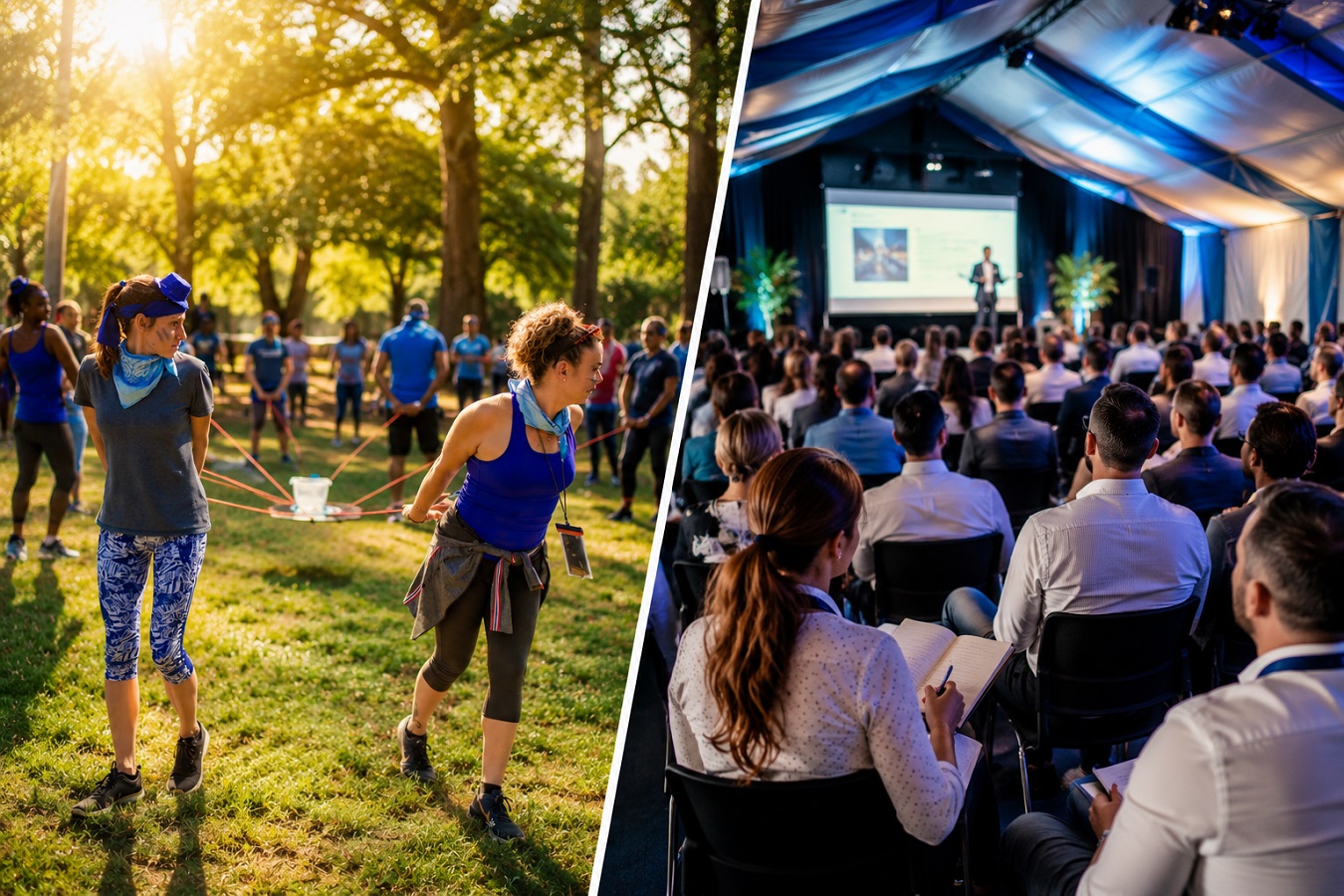
The real difference between a seminar and team building lies in the intention and purpose. A company seminar advances a fundamental issue. Team building improves the quality of relationships between people. For an annual kick-off, the most effective combo is to organise a seminar in the morning with workshops, followed by a team-building activity in the afternoon.
Seminar with integrated team building: the winning combo in 2026
In 2026, the trend in corporate events is clear: hybrid team-building seminar formats are on the rise. A residential seminar with an integrated team-building session allows you to deal with the substance in the morning, and then bond the team afterwards.
At Whereez, you can find venues and events in one place, with a vetted selection, a free quote and personalised support. There are formats to suit all team sizes and budgets. Discover our venues and activities for organising a summer seminar.
FAQ - Seminar or team building
How do you choose between a residential seminar and a traditional corporate seminar?
The choice between a residential seminar and a traditional seminar depends mainly on your objectives and the depth of the work expected. A residential seminar, including one or more overnight stays, encourages informal exchanges and prolonged immersion, facilitating in-depth reflection, which is useful for complex strategies or large-scale projects. conversely, a traditional seminar lasting a few hours or a day is suitable for more targeted operational issues with less immersion.
What indicators can be used to measure the success of a team building event?
There are a number of indicators that can be used to assess the effectiveness of a team building event: a perceptible improvement in internal communication, a reduction in tensions within the team, increased employee commitment, positive qualitative feedback during post-event evaluations, as well as lasting effects on cooperation and motivation in day-to-day work. These indicators are essential to justify the relevance of this type of event.
How can a team building session be effectively integrated into a company seminar programme?
Ideally, a team building session should be incorporated into a company seminar at the end of the day or during an extended break. After a morning of concentrated work on strategic or operational objectives, team building helps to relax the atmosphere, encourage cohesion and energise the teams. Planning this alternation encourages a balance between work and relaxation, which improves the overall support of the participants.
What are the long-term benefits of a combined seminar-team building programme for a company?
A combined seminar and team building programme creates a virtuous circle in the long term. This duo becomes more effective by improving informal communication, developing interpersonal skills and reinforcing employees' commitment to the company's objectives.